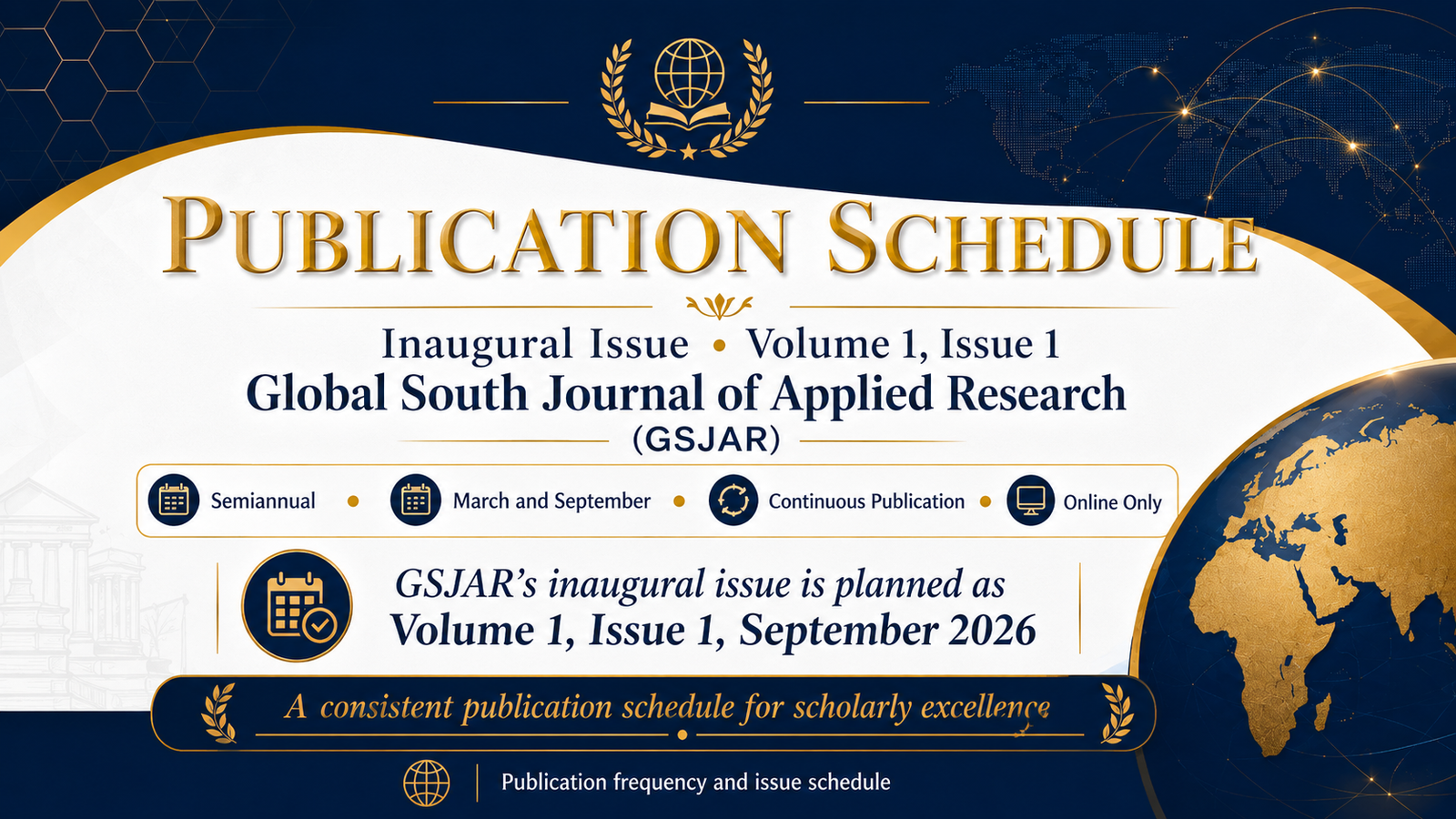
GSJAR Publication Schedule and Inaugural Issue
2026-06-27
GSJAR is published semiannually, with regular issues scheduled for March and September.
Read more about GSJAR Publication Schedule and Inaugural IssueThe Global South Journal of Applied Research (GSJAR) is an international, multidisciplinary, peer-reviewed and open-access scholarly journal dedicated to publishing rigorous, context-sensitive and solution-oriented research relevant to the Global South.
The journal provides a platform for researchers, educators, practitioners, professionals, policymakers and community-based knowledge contributors whose work addresses practical challenges affecting societies, institutions and communities. GSJAR encourages research that connects evidence, theory, policy and practice and recognises that complex challenges in education, health, psychology, governance, economics, technology, sustainability and social inclusion often extend beyond the boundaries of a single discipline.
The journal particularly welcomes scholarship that is locally grounded, methodologically transparent, ethically conducted and capable of generating meaningful implications for policy, professional practice, institutional development, community wellbeing or future research. It also seeks to strengthen the visibility of research produced in and about historically underrepresented regions while promoting equitable South-South and South-North scholarly exchange.
The vision of GSJAR is to become a trusted international platform for applied scholarship that is locally grounded, methodologically rigorous, socially responsive and globally relevant.
The mission of GSJAR is to advance the production, dissemination and practical use of high-quality research addressing real-world challenges in Global South contexts. The journal promotes rigorous applied, interdisciplinary and transdisciplinary research; strengthens the visibility of scholarship originating from underrepresented regions; connects research findings with policy, professional practice, institutional priorities and community needs; encourages equitable and ethical research collaboration; supports context-sensitive theories, methods and interventions; facilitates scholarly exchange among researchers, practitioners, policymakers and institutions; and advances open, inclusive and responsible scholarly communication.
GSJAR uses the term Global South as an analytical and relational concept rather than as a fixed geographical classification. It broadly refers to societies and communities across Africa, Asia, Latin America and the Caribbean, the Middle East and the Pacific that have experienced unequal participation in global systems of knowledge production, economic development and institutional power.
The journal also recognises that structural inequality, social exclusion and economic marginalisation may exist within countries conventionally associated with the Global North. Research concerning such communities may be considered when its relevance to Global South scholarship, comparison, collaboration or knowledge exchange is clearly demonstrated.
GSJAR does not treat the Global South as culturally, politically, historically or economically homogeneous. Authors are therefore expected to identify the specific geographical, social, cultural, institutional and historical context of their research and avoid unsupported generalisations.
The journal publishes original and significant research that contributes to the understanding and resolution of practical problems. It welcomes quantitative, qualitative, mixed-method, experimental, evaluative, participatory, action-research, implementation-research, design-based and interdisciplinary studies.
Research may be local, national, regional, international or comparative, but every submission must demonstrate substantive relevance to Global South contexts, priorities, communities, institutions or systems.
The journal considers research in education, learning and human development, including educational policy, teaching and learning, teacher education, curriculum, assessment, educational technology, inclusive education, higher education, vocational education, lifelong learning, and childhood and youth development.
It also considers work in psychology, health and community wellbeing, including applied psychology, mental health, public health, community health, counselling, behavioural science, wellbeing, disability, rehabilitation, health education, social care and community-based interventions.
Research in governance, law and public policy may address public administration, governance, institutional reform, legal and regulatory studies, public-service delivery, decentralisation, social justice, citizenship, accountability and evidence-informed policymaking.
The journal welcomes studies in business, economics and livelihoods, including management, entrepreneurship, labour, employment, financial inclusion, informal economies, small enterprises, social enterprise, organisational development, development economics and sustainable livelihoods.
Submissions in technology, innovation and digital society may address digital transformation, artificial intelligence, information and communication technology, digital inclusion, responsible innovation, technology adoption, educational technology and technology for social development.
Research in environment, agriculture and sustainability may include climate resilience, environmental governance, sustainable development, agriculture, food systems, natural-resource management, rural transformation, disaster-risk reduction and community-based sustainability.
The journal also publishes research on equity, inclusion and culture, including gender, disability, social exclusion, indigenous and local knowledge, migration, poverty, marginalised communities, cultural diversity, human rights and inclusive development.
Work in research methods, evaluation and implementation may address research methodology, psychometrics, programme evaluation, impact assessment, implementation research, monitoring and evaluation, evidence synthesis, measurement and context-sensitive research tools.
A manuscript will normally fall within the journal’s scope when the research has been conducted substantially within a Global South context, addresses a problem or institutional priority relevant to Global South societies, makes a theoretical, methodological, policy or practice contribution based on Global South evidence, presents a meaningful comparison involving one or more Global South contexts, advances South-South or equitable South-North collaboration, or examines marginalised communities and structural inequalities with clear relevance to Global South scholarship.
The nationality, residence or institutional affiliation of an author does not independently determine eligibility. The substantive relevance, originality, quality and contribution of the manuscript are the primary considerations.
Submissions must present a clearly defined and significant research problem, engage appropriately with relevant scholarship, use a suitable and transparently reported methodology, comply with applicable research-ethics requirements, interpret evidence accurately and responsibly, and explain their implications for policy, practice, institutions, communities or future research.
Authors must represent participants and communities respectfully and contextually, avoid harmful or unsupported generalisations, and demonstrate that the manuscript makes an original and meaningful contribution to knowledge.
The journal will normally not consider manuscripts that lack a clear applied, policy, professional or practical contribution; purely descriptive studies without substantive analysis; personal opinions presented as research; manuscripts without meaningful relevance to the Global South; highly specialised clinical, laboratory or engineering studies beyond the competence of the journal’s editorial and reviewer network; commercial or promotional material; research lacking mandatory ethical approval or informed consent; fabricated, falsified, plagiarised or improperly attributed work; or manuscripts generated substantially through artificial intelligence without responsible human authorship, verification and appropriate disclosure.
GSJAR welcomes original research articles, review articles, policy and practice papers, case studies, field reports, brief research reports, methodological papers, implementation and evaluation studies, evidence syntheses, invited perspectives, editorials and book reviews.
The journal is intended for researchers and academics, university and college faculty, doctoral and postgraduate scholars, educators and teacher educators, policymakers and public administrators, health and psychology professionals, social-care practitioners, development professionals, non-governmental and community organisations, business and social-enterprise professionals, technology and innovation specialists, programme evaluators, research-methodology experts, and international and regional development institutions.
Journal Summary: GSJAR is an international open-access journal advancing rigorous, context-sensitive and applied research relevant to the Global South. It publishes empirical, review, policy, practice, implementation, evaluation and methodological contributions that connect research evidence with institutional, professional, policy and community priorities.
GSJAR provides an international platform for locally grounded and ethically conducted scholarship addressing real-world challenges in Global South contexts. Its multidisciplinary coverage includes education, psychology, health, governance, business, technology, sustainability, social inclusion and development.
Locally Grounded Research for Inclusive and Sustainable Futures.
GSJAR is an online-only, peer-reviewed and open-access journal published semiannually in March and September. It follows a continuous-publication model within each active issue. Articles may be published after successful completion of editorial screening, peer review, revision, final editorial decision, copyediting, proofreading and production.
The primary publication language of GSJAR is English. Authors are responsible for submitting manuscripts that are clear, accurate and professionally written. Additional translated titles, abstracts or keywords may be accepted where appropriate and technically supported by the journal.
The Global South Journal of Applied Research (GSJAR) is owned and published by Educators Plus, New Delhi, India. Educators Plus is responsible for the journal’s publication infrastructure, website administration, technical management, digital dissemination and publication-support services.
The journal maintains full editorial independence. Decisions relating to manuscript screening, peer review, reviewer selection, revision, acceptance, rejection and publication are made by the journal’s editorial team in accordance with academic merit, editorial policies, ethical standards and the journal’s aims and scope.
The publisher does not interfere with editorial decisions on the basis of commercial, financial, institutional, political or personal considerations.
Publisher: Educators Plus
Place of Publication: New Delhi, India
Journal Title: Global South Journal of Applied Research
Journal Abbreviation: GSJAR
Journal Website: https://gsjar.org/index.php/gsjar
Publisher Website: https://educatorsplus.org
General and Administrative Email: contact@gsjar.org
Editorial and Manuscript Email: editor@gsjar.org
Publication Format: Online only
Publication Language: English
Publication Frequency: Semiannual, with issues published in March and September
Publication Model: Continuous publication within the active issue
Access Model: Immediate open access
GSJAR is published semiannually, with regular issues scheduled for March and September.
Read more about GSJAR Publication Schedule and Inaugural Issue